
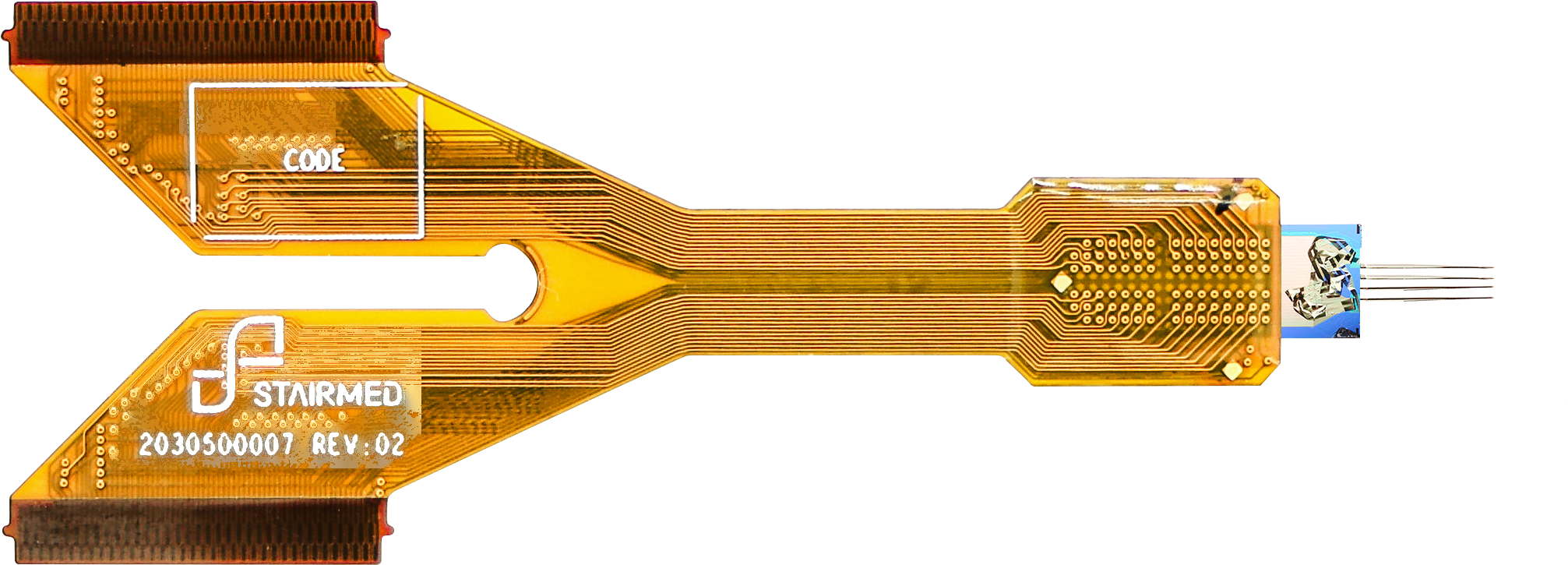
Mouse electrode 160-128-4
Ultra-flexible micro-nano electrode for in-vivo mouse and rat ephys. 128 channels on 4 shanks with 1.1 mm site coverage, for LFP and spikes in acute or chronic studies.
- Ultra-flexibleSubstrate bending stiffness is only 10⁻¹⁴ N·m² … far below typical implantable electrode materials.
- Long-term stabilityStable signal capture for up to 300 days.
- High densitySite layout supports high spatial sampling, up to 1024 channels/mm².
- UltrafineImplant filament is only 2 μm thick; smallest site diameter is 20 μm.
- High biocompatibilityLow tissue injury and immune response for long-term stable recording.
- High throughput128 channels per device; multiple devices can be implanted side by side.
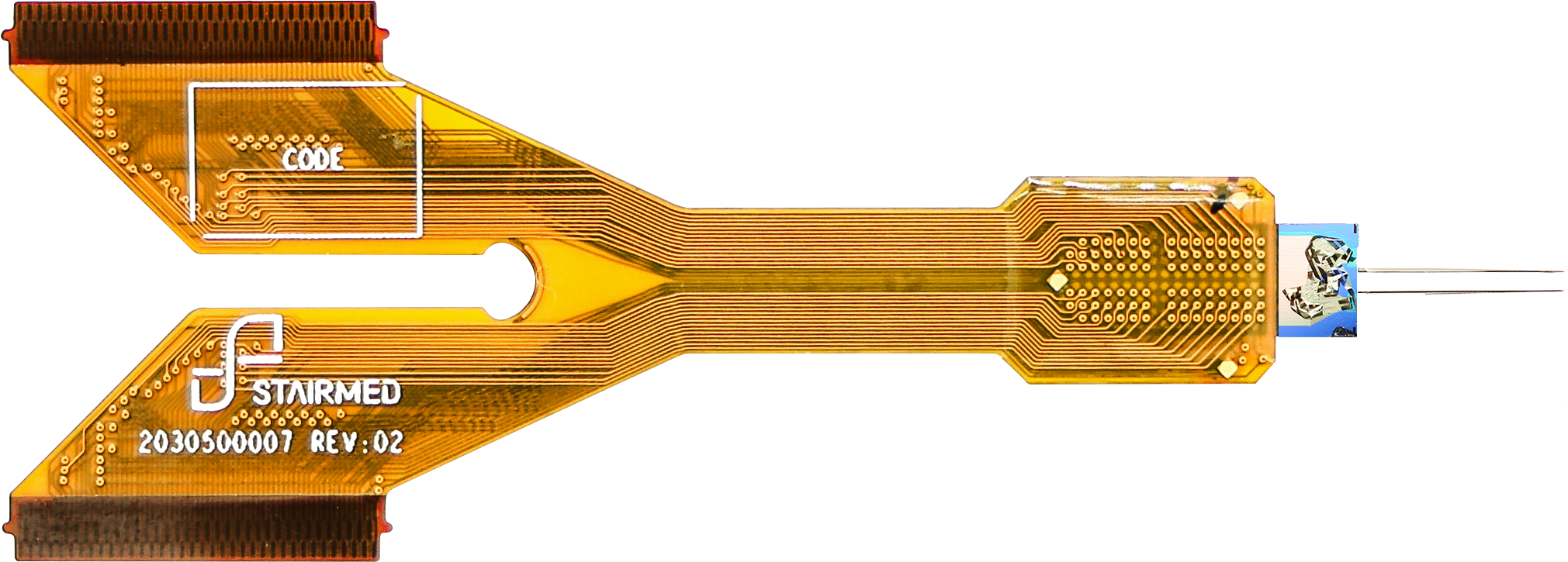
160-128-4 pairs a flexible film with tungsten-needle assisted insertion and a Y-flex connector for DAQ. Sites are 16×25 μm at 35 μm pitch; tungsten needles are 4 mm long at 0.25 mm spacing … suited to cortex, hippocampus and similar mid-shallow targets. Channel map and package I/O can be customized.
Flexible
Soft substrate to cut mechanical injury at implant and after.
Low trauma
Micron-scale filament and sites, milder immune response.
Throughput
128 channels per device for large-scale ephys.
Customizable
Channel map, coverage and I/O matched to the paradigm.
System I/O
FPC / connector interfaces for common DAQ systems.
| Model | 160-128-4 |
|---|---|
| Species | Mouse, rat |
| Channels | 128 |
| Shank count | 4 |
| Site coverage | 1.1 mm |
| Site size | 16 × 25 μm |
| Site pitch | 35 μm |
| Tungsten pitch | 0.25 mm |
| Tungsten length | 4 mm |
| Signals | LFP / spikes |
Outline, site map and connector drawings are available on request.
Acute and chronic mouse/rat work … cortex, hippocampus and nearby nuclei … plus BMI paradigm validation.

Applications
 Mouse ephys
 Rat cortical recording
 BMI experiments
 Circuit studies
 Chronic implants